

Victor Fet: «We Grew Up in the Glow of Ashes»
During the four years of war in Kyiv, four Russian-language anthologies titled God poezii (Year of Poetry) were published. Their authors live in different countries, write in Russian, and express solidarity with Ukraine. Who are these people? How did the anthologies evolve, and what's next? Victor Fet, poet, translator, poetry anthologist, and biology professor at Marshall University in West Virginia, answers Radio Liberty's questions.
— Thanks to your energy and experience, the Year of Poetry annual anthology was published. Where did the idea come from?
— I am familiar with this field because I have long been involved in various projects run by the writer, poet, and publisher Vladimir Batshev. He is the editor of two expat Russian-language magazines: a monthly Literary European for nearly three decades, and since 2004, the quarterly Bridges. Both are published in Germany with subscriptions and distributed worldwide. Before the Russian invasion of Ukraine, I spent four years helping Batshev compile the annual anthology Day of Russian Expat Poetry. And immediately after the tragic February 24th, I had the idea of publishing a poetry collection in Kyiv — as an expression of solidarity with Ukraine.
— How did you choose the publisher?
— Year of Poetry is published by Oleg Fedorov’s Drukarsky Dvir Publishing House. Since 2002, this organization has published over a thousand book titles in both Ukrainian and Russian, and over five million magazines. Collaborating with Oleg Fedorov is an honor for me. In four years, we have published four full-length volumes. The covers of our books — beautiful and full of tragedy — are created by Kyiv artist Mykola Sologub.
— Are the poems primarily about war?
— Not only that, but it is important for us to provide a cross-section, a spectrum of what Russian-language authors in different countries are feeling and writing today. There are also themes that I find inappropriate, as they say, out of season, like light humor.
— In contemporary Russian literature, swearing is rampant. What about on the pages of the Year of Poetry?
I do not accept texts saturated with obscene language.
— How are the works and authors selected?
— The compilation and selection are my responsibility — I invite those I know and those recommended to me. Each collection is about six hundred pages long and features one hundred authors — four to five pages each. About a quarter of the authors are Ukrainian poets writing in Russian. They are invited by the publisher. They live in Kyiv, Kharkiv, Odesa, Zaporizhzhia, Zhytomyr, Mogilev-Podolsky, and other Ukrainian cities. The rest of the book is devoted to poets writing in Russian in the diaspora: Europe, the USA, Canada, Israel, even New Zealand. The authors represent many generations — from long-time emigrants who left the USSR in the 1970s and 1980s to refugees of 2022 who fled independent Ukraine after the onset of full-scale Russian aggression.
One of the book’s unique features is that we provide no biographical information about the authors, only their names and countries of residence. Let the reader judge by their texts, not their regalia. The names of Ukrainian poets writing in Russian are familiar to many; I will name a few: Andrey Kostinsky, Karine Arutyunova, Sergey Shelkovy, Denis Golubitsky, Inna Kvasivka (Kutsenko), Aleksandr Ratner, Dmitry Bliznyuk, and others. Some of them are currently in Europe, for example, Boris Khersonsky, Irina Yevsa, and Irina Karpinos. And the remarkable poet Palad (Pavel Rytsar) has been fighting in the Ukrainian Armed Forces for four years.
A strong group of voices from Israel includes both long-time repatriants (Olga Agur, Dina Meerson, Vadim Groysman, Boris Kamyanov, Dina Berezovskaya, and others) and recent refugees from Ukraine (Victoria Nikolaeva). Emigrants who have lived for many years in both Europe (Irina Yurchuk, Emilia Pesochyna, Olga Zveryeva, Nina Geide, Victor Kagan, Vitaly Amursky, and others) and overseas — Galina Itskovich, Dmitry Bobyshev, Sasha Nemirovsky, Anna Galberstadt, Marina Genchikmakher, David Potashnikov, and others — also contribute their experience. Many are inextricably linked to Ukraine through their roots and biographies.
According to existing wartime regulations, the book does not include authors from Russia and Belarus. Anti-war poetry currently being created in Russia is the subject of a separate discussion and archiving.

— Does the Year of Poetry series have pages for prose writers?
— We include critical essays and articles on poetry. Each issue traditionally features a review of the previous year’s collection, including reviews by Anatoly Liberman (USA) and Bertha Frasch (Germany). Last year, we published an article on the poetry of artificial intelligence. Mikhail Epstein (USA) co-authored it with AI. AI’s poems, under the name «Claude Opusov», are also included in the book.
We have also published essays on other literary projects. The international project Kopilka (Coin Bank), for example, collects and translates wartime poetry into English and French. And poet Nikolai Lobanov has been publishing his anthology Artelen in Kyiv since 2012; 17 volumes have already been published in Russian and several in Ukrainian.
The «In Memoriam» section is dedicated to the memory of deceased poets, including collections of poems and essays about their authors. There are also memorials for Vasyl Drobot, Viktor Shendryk, Bakhyt Kenjeev, Arkady Shtypel, and Alexander Vernik; and the remarkable haiku master and philosopher from Sumy, Sergei Kurbatov (1971-2023). The final volume features Irina Mudrova (1967-2024) who died in Kharkiv under attack from Russian missiles, and the young poet Vlad Loza (1999-2024), who gave his life for Ukraine in the ranks of its Navy.
— Has the almanac changed over time? What are the main themes?
— Over the years of war, both the authors and the texts have changed. Some poets of the older generation, alas, have passed away. Others have fallen silent, unable to write in Russian any longer. Random themes have disappeared. At the same time, a lot of poetry is being written, and we have stopped publishing a number of texts that we consider unnecessary, such as translations into Russian. Many authors now have so many wonderful poems that it is difficult to choose. Often, poetry is saturated with curses, rage, pain, and anger. It’s often impossible to read poems without tears.
And, of course, we have run out of texts lamenting the divergent fates of «brotherly peoples», the «shared Soviet past», the «fratricidal» war, and the future reconciliation along the lines of «this too shall pass». It won’t pass and won’t be forgotten.
Poesie als Brücke: Iryna Yurchuk über die Sprache und das Leben
— What will the new Year of Poetry be like?
— Our books are being published by the New Year. Work on the upcoming collection has already begun. I am constantly told that our Year of Poetry supports people during the terrible war. I think it is important to capture the spectrum and cross-section of poetic resistance texts born during the war. Also, we plan to incorporate texts in Ukrainian in the collection for the first time. These will include translations into Ukrainian of contemporary Russian-language Ukrainian authors, as poet and translator Irina Yurchuk did in her book Nadzemnyi perekhid (Overground Passage), published last year by the same Kyiv publishing house of Oleg Fedorov.
— Where can one find the Year of Poetry?
— The electronic version of the Year of Poetry is sent free of charge: email me at vf******@***il.com, оr go to: druk-dvir.prom.ua The hard-covered paper edition is limited and is distributed by pre-order, primarily by authors. The rest of the print run is sold in Kyiv.
Of course, there are other poetry anthologies and similar websites online. But consider this: for four years in a row, during Russia’s war against Ukraine, a Russian-language poetry collection has been published in Kyiv. I am convinced that our book serves to unite people on Ukraine’s side. We strive to capture the memory of the tragic war years.
It is also important that our poems speak the «language of the enemy», as Russian is the native language of all our authors, including myself. We can stop writing in it — as many have done in despair, as Andrey Gritsman’s tragic article «Renouncing Poetry» explores in our 2024 volume. But we can also use it as a tool — a weapon against the aggressive «Russian world», against «rushism». This is difficult, because our language is mentally resistant; it has undergone a rigorous selection process for archaism, infantilism, and prison camp speech. Ekaterina Margolis, in particular, writes about this convincingly and in detail.

— In your poem «No Words», you address Pushkin:
«There are no words. Your legacy has sunk
into the Azov sand. Tsarskoye Selo
has been destroyed. The fountain in Crimea has run dry.
Your language, that is, ours, is anchar juice
from glass tomato cones,
like blood from a book of military victories
from the walls of Tmutarakan to Poltava.
But the time has come — and your state is no more.»
Are there really no words?
— They are running out. Poetry is being written, of course, but overall, there’s almost nothing to say in Russian. In my opinion — and I see this landscape even within our collections — the language of our ancestors is rapidly shrinking. Its authority is compromised. After all, too much of it, starting from Derzhavin, has always been tied to war, the glory of arms, the thunder of victories where «the voice of a single person is less than a squeak» (Vladimir Mayakovsky), death for mythical Grenada in the steppes of Ukraine (Mikhail Svetlov), «so that my Motherland may shine from Japan to England» (Pavel Kogan). Just as the caricatured attempt to revive Orthodoxy became yet another Kirillovism, so the insane victory-mania (pobedobesie) of the Führer-und-Volk has finally corroded the rotten foundations (skrepy).
Therefore, it seems to me that Russian culture has long since lost its spiritual content, its vibrant potential, and its best traits and texts, everything we loved and cherished, from Chekhov to the Strugatskys, from Boratynsky to Okudzhava, have become history. The squabbles of the first wave of emigration a century ago are absolutely relevant to us, and therefore we have no other words. We grew up in its glow over the ashes, dancing on the bones. History can’t be reduced to jokes, to Ilf and Petrov, but we grew up on them in our stagnant times, blindfolded. You can’t watch «The Irony of Fate» for half a century straight, with vodka, herring «under a fur coat», and Olivier salad, and pretend it’s a glorious tradition. And now comes a bloody macabre, a disgrace, which has no words.
— The Ukrainian Russian-language poet Alexander Kabanov has an image of a poet who is «between two tongues of fire». What does this mean to you?
— Ukraine is in a unique situation. Most likely, the Russian language, a legacy of the empire, will naturally disappear from an independent Ukraine, just as it is leaving the Baltic states and Transcaucasia. I agree with Iryna Berlyand that Russian should assume the status of a foreign language in Ukraine. This statement is no longer paradoxical. But it will take time, a generational change. In the meantime, those who grew up in Ukraine, and especially those who write in Russian, find themselves in precisely the situation described by Kabanov. History brought us here, primarily aggressive, colonial Russian history. And now the war crimes of many Russian speakers are essentially resetting the development of Russian culture. Time will do the rest.
Iryna Berliand : « La langue russe a été un instrument de destruction de l’identité ukrainienne »
— But Russian-language authors continue their work in Russia and abroad.
— Of course, because life goes on. However, I would like to emphasize that poetry is a special medium, semi-conscious, perhaps like painting or music. I believe it is much more deeply rooted in the subconscious than prose, from which poems emerge in the language they choose — if they have a choice. As for me, there is no choice: I write poetry exclusively in Russian, and I’ve been doing so almost daily for four years now. I also publish my books in Kyiv.
— Time seems frozen; every day of the war is February 24th.
— We are not simply in another period of timelessness, a freeze. I think the cyclical model, to which many turn with hope, is broken, and our history — not according to Fukuyama, but according to Saltykov-Shchedrin — has ‘stopped its flow.’ I left the USSR in 1988. And as a longtime émigré observing the history of the Russian-speaking world from afar for almost 40 years, it seems to me that it’s practically over. The world war is breaking it.
— Will the Russian language suffer the same fate as the dead Latin?
— I do not think so — much worse. Latin has fared much better. From Rome, new Romance languages spread across the world, originating from Latin, like birds from dinosaurs — it is evolution. Another example of a different fate is the revival of Hebrew by enthusiasts. In the post-Soviet world, Russian will remain the language of formal communication for some time, but mobilization, emigration, and demographics are taking their toll, and in about forty years, counting on the traditional Mosaic scale, «this place will be desolate».

— However, the war crimes of German-speaking Nazis didn’t interrupt the transmission of the German language from generation to generation. So why will Russian die out?
— In my view, it is a matter of biology, of the timing of selection. After all, the German nightmare lasted less than a generation. Brainwashing, propaganda, defeat, occupation, and repentance — all of this happened in 20-25 years. That’s very fast. But the current nightmare affecting Russian, Russian-speaking, and Russian culture has lasted for over 100 years, even if we only count since 1917. Memory is fading, distorted. The destruction and selection of culture have led to a society that can no longer be repaired; it will crumble and disappear. I think that what we’re talking and writing about now is incomprehensible to millions of people in Russia, just as the barbarians couldn’t understand the sounds of Catullus, but at least he has survived in translation.
The dynamics are such that over the past three or four years, even the various concepts of the «Russian opposition» about ending the war and the possibility of a relatively stable peace with Russia have disappeared. Clearly, without a crushing military defeat for the Russian state, so that the hydra cannot recover, there will be no repentance. But wars throughout history have lasted for a hundred years or more, ebbing and flowing. My grandmother, who grew up in Odessa, described her youth before 1914 as «peacetime»… after that, for her, there was no peacetime.
— What about the poetry of resistance?
— Sometimes people say to me, «You and your authors are doing an important job, saving our Russian language from shame». It’s flattering to hear. But I am more of a pessimist (or a realist), and I confess I do not think this is possible. The guilt, failure, corruption, and desertification of this civilization, culture, and with it, language, have apparently already gone so far that there’s hardly any talk of salvation. But we can add our voices to a position of responsibility and repentance, of deliverance from personal shame, of complicity in silence, and declare our position before this culture disappears.
— In that case, who will read the Year of Poetry in forty Moses’ years?
— Who knows? In a review of our 2024 volume, Anatoly Liberman wrote: «In such years, it’s natural to think about the future, but the prophets of all ages have foreseen only catastrophes». Good poets are like prophets; perhaps some of our texts will survive in new codices.
My native language is a complex, uneven amalgamation formed over a very short historical period, just over two hundred years. Perhaps the vast body of Russian-language poetry, from Pushkin to Alexander Blok and Bulat Okudzhava, will be studied by graduate students somewhere in Kyiv, Avalon, or Atlantis. For them, I hope, these and other important texts will be preserved in silicon memory, in the catacomb-monasteries of planetary intelligence.
The translation was made by Victor Fet
- Минотавр и приличный человек. О фильме Андрея Звягинцева - 19 сентября 2026
- Тамиздат в Праге: книжная башня вне цензуры - 15 сентября 2026
- «Береги і обереги». В Киеве под бомбами продолжают издавать книги – в том числе русскоязычные - 10 сентября 2026
Images:
Four volumes of the anthology Year of Poetry (Kyiv) (Courtesy Photo)
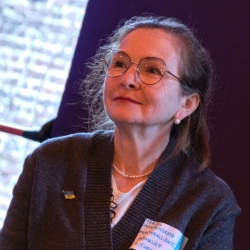
Victor Fet (Courtesy Photo)


Поделитесь публикацией с друзьями